Day: March 5, 2015
Pomegranates
Pomegranates have been prized for their nutrition value for more than 4,000 years, especially in the ancient world of the Middle and Near East.
Now, research shows that this time-honored fruit can fight heart disease…support healthy cholesterol levels…lower blood pressure…relieve stress…improve your sex life…and, according to a brand-new study, even slow down the aging process of DNA.

Pomegranate Benefits: An Anti-Aging Super Food
In November of 2011, scientists from the ProbelteBio laboratory in Murcia, Spain conducted a month-long study of the effects of pomegranate extract. The study focused specifically on the pomegranate’s rich stores of antioxidants (important compounds that prevent age-related cell damage).
The research team recruited two groups of volunteers. The first group was given extracts of the whole pomegranate fruit in capsule form (extracts included the pith or membrane, peel, and seeds). The second group received a placebo.
The research team was highly impressed with their results. Those who took the pomegranate extract showed a significant decrease in a specific, important marker linked to cell damage.
That marker, known as 8-Oxo-DG, can have detrimental effects such as:
- • Lessened brain function
- • Weakening of muscles
- • Impaired kidney function
- • Decrease in liver productivity
- • Aging of the skin
Sergio Streitenberger, lead researcher at ProbelteBio, believes the study “demonstrates that the regular consumption of this pomegranate extract can slow down the process of DNA oxidation.”
The pomegranate’s ability to decrease 8-Oxo-DG suggests that it wields significant power as an anti-aging super food.
Why Antioxidants Are The Ideal Anti-Agers
Antioxidants are crucial for preventing and reversing aging because they stop damage wrought by destructive free radicals.
“One way to look at aging is to think of it as rusting,” Streitenberger said, “or oxidizing.” Free radicals oxidize our body’s molecules. Everyday we take in these dangerous compounds in the food we eat, the beverages we drink, and even the air we breathe. “We get old because we fall apart cell by cell,” said Streitenberger.
Sandeep Prabhu, assistant professor of immunology and molecular toxicology at Penn State, says that foods especially rich in antioxidants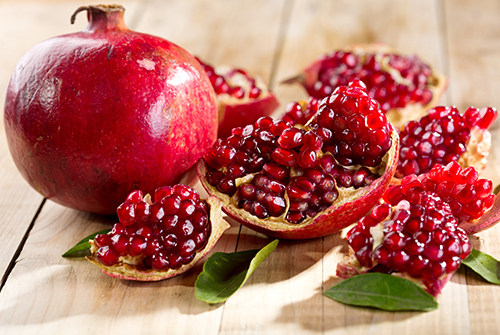 —such as pomegranates—qualify as anti-aging super food because they have “the ability to neutralize harmful molecules in our cells.”
Once free radicals reach the DNA of our cells, Streitenberger warns, “the damage is cumulative and significant.” This is why the ProbelteBio study is so astounding. For any food to so effectively guard against the aging process “would be a significant breakthrough,” says Streitenberger.
A Pomegranate A Day…Unbelievable Benefits
Some scholars believe the forbidden fruit said to have tempted Eve in the Garden of Eden was actually a pomegranate, not an apple. It could have been a mistranslation, because the word pomegranate comes from the Middle French pomme garnete, literally “seeded apple.”
Therefore, you might consider the pomegranate as the deluxe version of the apple, capable of so much more than simply keeping the doctor away.
But it’s important to remember that experts say the most potent pomegranate benefits come from consuming the whole fruit, not just the delicious seeds. Most commercial juices draw their content only from the seeds, and contain only small quantities of the powerful antioxidants that protect against aging. The real powerhouses are the inedible rind, hulk, and white pith.
These non-seed parts of the fruit are described as “inedible” not because they are toxic, but due to their bitter taste and unpleasant texture. With that in mind, heath practitioners recommend that you consider taking a supplement pill or health drink made with extracts of the whole fruit.
Citrus Fruits and Tea Can Help Lower Ovarian Cancer
New research reveals that women who consume foods containing flavonols and flavanones (two forms of dietary flavonoids) cut their risk of developing epithelial ovarian cancer. This is amazingly good news for women, because ovarian cancer is currently the 5th leading cause of cancer death among women. About 20,000 women in the U.S. are diagnosed with ovarian cancer each year.

An Extremely Deadly Cancer
Ovarian cancer is one of the deadliest of all cancers affecting women. One of the reasons this type of cancer is so terribly dangerous is that it is nearly impossible to detect early. Only about 19% of ovarian cancer is diagnosed before the cancer has spread, after which point treatment is usually not effective.
Making matters worse is the fact that the ovaries are tiny organs located deep within the abdominal cavity. This makes it extremely difficult to pinpoint symptoms specific to the ovaries. Sadly, such symptoms are all too often mistaken for other far less serious health issues until it is simply too late.
The good news is that there are choices you or your loved ones can make to lower ovarian cancer risk. Most recently, scientists at the University of East Anglia (UEA) discovered that tea and citrus fruits and juices can lower ovarian cancer risk.
How Tea and Citrus Prevent Ovarian Cancer
The UEA study followed the dietary habits of 171,940 women between the ages of 25 and 55 for more than three decades. The research team found that those who consumed food and drinks high in flavonols were less likely to develop ovarian cancer.
Flavonols are found in…
- Tea
- Red wine
- Apples
- Grapes
Consumption of flavanones was also associated with lower incidence of ovarian cancer.
Flavanones are found in …
- Citrus fruits
- Citrus juices

| Two Cups A Day The consumption of just two cups of black tea every day was associated with a whopping 31% reduction in ovarian cancer risk. Black tea also slashes your risk of diabetes. A study of elderly people living in the Mediterranean islands showed that people who consumed 1-2 cups of black tea a day had a 70% lower chance of having or developing Type 2 diabetes. |
A Groundbreaking Study
The UEA study was the first large-scale study to examine how the substances in black tea and citrus fruits and juices affect the risk of ovarian cancer. The study’s authors concluded that very simple and inexpensive changes in food intake could have a drastic effect on reducing ovarian cancer risk.
 HealthyDad